B1 Independent user

CEFR B1: Intermediate

Learners understand the main points of clear, standard input on familiar matters. They can deal with most travel situations, produce simple connected text, describe experiences and ambitions, and briefly give reasons and explanations.

Learners at B1 can…

  • Describe experiences, events, hopes and plans with reasons
  • Keep a conversation going on familiar topics
  • Understand the main ideas of TV programmes, articles and stories on familiar subjects
  • Write connected text: emails, stories, short essays and reviews

Teaching focus

The "intermediate plateau": push fluency with discussions and tasks, widen vocabulary (collocations, phrasal verbs) and introduce conditionals, passives and reported speech.

Approx. guided learning hours: 350–400
Exams: Cambridge B1 Preliminary (PET) · IELTS approx. 4.0–5.0

Grammar to teach at B1

Grammar syllabus
Present perfect vs past simpleUnfinished time and life experience vs. finished, specific past time.Present perfect with for / sinceActions and states that started in the past and continue now.Used toPast habits and states that are no longer true.Zero & first conditionalGeneral truths (zero) and real future possibilities (first).Second conditionalImaginary or unlikely situations in the present or future.Passive voice (present & past simple)Focus on the action or the thing affected, not who did it.Defining relative clauseswho, which, that, where, whose — to identify which person or thing we mean.Gerunds & infinitivesWhich verbs are followed by -ing and which by to + infinitive.Modals of deduction (must / might / can't)Say how sure you are about something in the present.Reported speech (statements)Report what someone said, usually moving tenses back.Too / enoughSay there is more or less than needed.Future forms: will, going to, present continuousChoosing the right future: decisions, plans and arrangements.Question tagsShort questions at the end of a sentence to check or confirm.Present perfect continuousFor activities that started in the past and are still going on, or that have just stopped and have a result now.Quantifiers: all / most / some / none / every / eachSay how many or how much of a group: all, most, some, none, every and each.Linking words of contrast: although / however / despite / in spite ofJoin two different or surprising ideas with although, however, despite and in spite of.So / such (that)Use so and such to make adjectives and nouns stronger, and so/such … that to show a result.Both / either / neitherTalk about two people or things: both = the two, either = one or the other, neither = not one and not the other.Indirect questionsPolite questions that start with a phrase like "Could you tell me…?" and use statement word order.

Vocabulary topics at B1

All topics

Printables for B1

All B1 resources
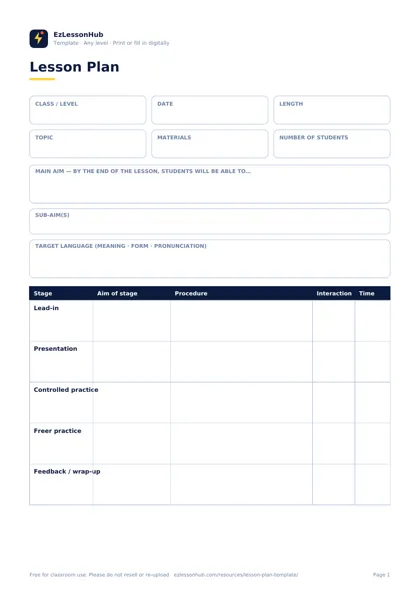
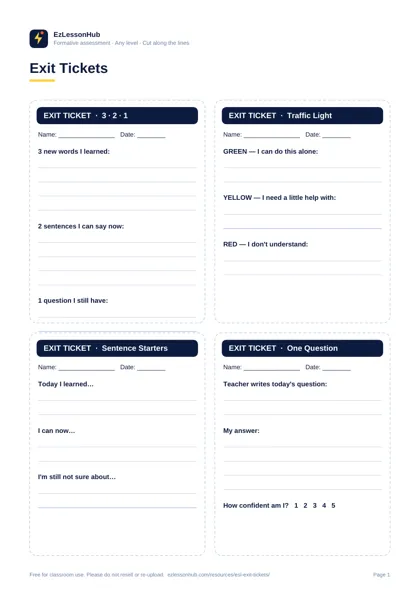
Preview of ESL Lesson Plan Template

ESL Lesson Plan Template

A two-page lesson plan template: aims, target language, staged procedure, anticipated problems, differentiation and reflection.

Teacher TemplatesA1–C1Free PDF